Barndominium Pros and Cons in New York: Snow, Heating, Appraisal and Resale
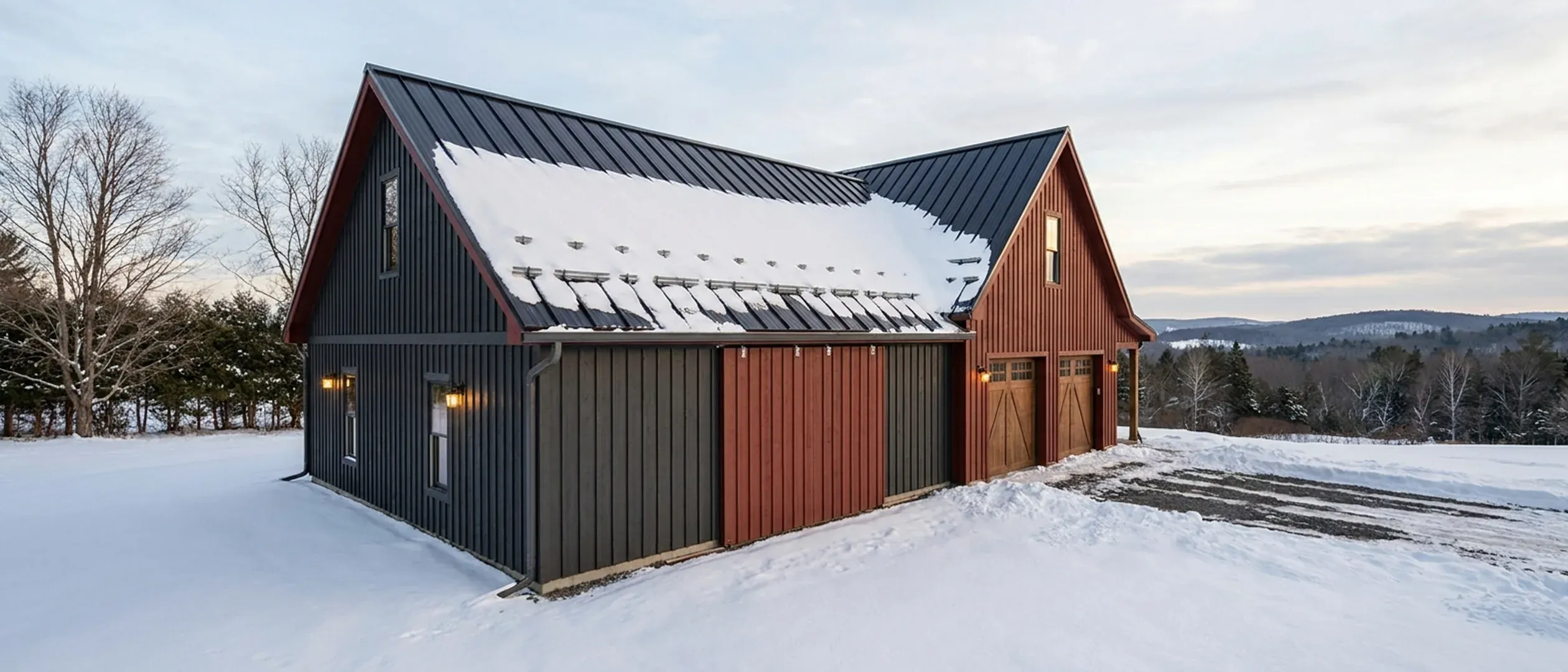
A barndominium is a house built with the structure of a farm or commercial building: a pole barn (post-frame) or steel frame, metal roof and siding, and an open interior that often shares a roof with a shop or garage. That structure brings real advantages, and some weaknesses that matter more in New York than in milder places. Winters are long, the areas downwind of the Great Lakes get heavy lake-effect snow, and most households heat with gas or oil, which a new building may not be able to use. Appraisal and resale depend on comparable sales, and rural New York has fewer of them. This page weighs the strengths against those conditions and says what to do about each weakness.
Figures on this page are cited third-party or government data, not a quote from New York Barndominium Builders.
Bottom Line Up Front
- The strengths are real: a clear-span frame that allows an open plan, a shop and house under one roof, and a metal roof that sheds snow and lasts.
- The weaknesses matter more in New York: heating a tall open space through a long winter, condensation behind metal panels, snow sliding off the roof, and appraisals that depend on comparable sales.
- Each weakness has a fix at the design stage: insulation and air sealing detailed for a cold climate, snow guards or a roof plan that keeps sliding snow away from doors, and a lender and appraiser who have handled one before.
Three different buildings, one word
"Barndominium" describes a look and a way of living, not one construction method. The pros and cons depend on which one you build.
Pole barn (post-frame) construction
Large posts set on or in the ground at wide spacing, with girts and purlins carrying the metal skin. Economical for large clear spans. See pole barn homes. The posts and their footings must be designed for frost and for the snow load on the roof.
Steel frame
Steel columns and rafters on a concrete foundation. Suits wide spans and tall shop doors. See steel construction.
Conventional framing with metal cladding
A wood-framed house finished with metal roofing and siding for the barndominium look. It is built and appraised like a conventional house.
Where a barndominium genuinely wins
Clear span and a floor plan you can change
The roof is carried by the frame, not by interior walls, so rooms can be laid out freely and changed later.
Shop and house under one roof
Equipment, vehicles, a workshop or a hobby space sit next to the living area without a separate building. See shouses.
A roof that sheds snow and weather
Metal roofing sheds snow and rain well and does not rot. Plan where the snow lands.
Tall walls and big doors
High ceilings, lofts and wide doors for equipment are straightforward in a frame designed for them.
Where it is weaker, and what to do about it
Condensation behind the metal
Warm indoor air meeting cold metal in a New York winter condenses. The fix is a continuous insulation and air-sealing layer designed for a cold climate, and ventilation that removes indoor moisture.
Heating a large volume
Tall open spaces take more energy to heat. Insulate the roof and slab edge properly, zone the shop separately from the house, and size the heating system for the actual design.
Appraisal and comparable sales
Fewer comparable sales in rural areas can make a barndominium harder to value. Choose a lender that has financed one, and give the appraiser full plans and specifications.
Too much house for the area
An appraisal rarely credits a building worth far more than the homes around it. Size the house and shop for how you will use them, not only for resale.
New York conditions to plan for
Snow load and sliding snow
The frame is designed for the ground snow load that applies at your site; the roof layout should keep sliding snow off doors, decks and driveways.
The heating system
Decide early, with the rules for new buildings in mind. See the legal guide.
Frost and foundations
Footings and post embedment must reach the frost depth your building department requires.
Codes and permits depend on where the land is
The permit comes from your city, town or village code enforcement office, or the county or the Department of State where the municipality has opted out; the zoning comes from your town, city or village; and the septic system goes to the local health department.
Reading this because you are weighing a build? The next step is a plan drawn for your program.
What's different about New York
Lake-effect snow and the roof
NOAA's New York State Climate Summary describes frequent heavy lake-effect snow over areas downwind of Lakes Ontario and Erie, including a November 2014 storm that dropped more than 5 feet of snow just east of Buffalo. A metal roof sheds snow well, which is an advantage, but snow sliding off a steep metal roof lands in a heap along the eaves. Keep entrances, walkways and parking out from under the eave lines, or add snow guards. The roof and frame are designed for the ground snow load your building department applies to your location.
A long heating season
The same summary puts the long-term statewide average winter temperature at 22.2°F. A barndominium's tall walls and open plan make a large volume of air to heat, so insulation, air sealing and the heating system matter more here than the frame does. Ask how the walls, roof and slab edge are insulated before comparing prices.
How New Yorkers heat, and what that means for a new build
The Energy Information Administration reports that about 6 in 10 New York households heat with natural gas, about 1 in 5 with petroleum products, mainly heating oil, and about 1 in 6 with electricity. Not every rural site has a gas main, and New York law directs the building code to prohibit fossil-fuel equipment in most new low-rise buildings; as of the Department of State's July 2026 notice, enforcement is suspended by court order while litigation continues. Settle the heating system at the design stage rather than assuming what the neighbours use.
Rain and flooding
NOAA's summary reports a large increase in extreme rainfall in New York since 1995, and recalls that Hurricane Irene brought more than 18 inches of rain to some locations in the Catskills in 2011. Check the flood map for any parcel near a stream or river, and keep the slab and shop floor above the surrounding grade.
Appraisals depend on comparable sales
Fannie Mae's Selling Guide says unique or nontraditional housing is eligible provided the appraiser has adequate information to develop a reliable opinion of value, and that rural properties may have a shortage of truly comparable sales nearby. Where no barndominiums have sold near your land, the appraiser may have to reach further for comparables, which can make the value harder to support.
A big shop can make a property look agricultural
Fannie Mae's guide says significant outbuildings, such as large barns or storage areas, may indicate that a property is agricultural in nature, and the lender must decide whether it is residential. A barndominium with a very large shop area can raise the same question, so talk to the lender before settling the shop size.
Pros and cons, honestly
Pros
- Open clear-span interior that can be rearranged later
- Shop, garage or equipment space under the same roof
- Metal roof that sheds snow and rain and does not rot
- Tall walls and wide doors are easy to build
- A kit shell can go up quickly once the foundation is in
Cons
- A tall open space costs more to heat through a long winter
- Condensation behind metal panels unless insulation and air sealing are done right
- Sliding snow off a metal roof needs planning around doors and paths
- Fewer comparable sales can make appraisal harder
- A very large shop can make a lender question whether the property is residential
- Heating choices for a new building need settling early
Are barndominiums a good idea in New York's climate?
How do barndominiums handle heavy snow?
Are barndominiums expensive to heat in a New York winter?
Do metal barndominiums have condensation problems?
Are barndominiums hard to appraise in New York?
Can I heat a new barndominium with gas or oil?
Do I need a permit to build a barndominium in New York?
Is a pole barn barndominium suitable for frost?
Questions answered? Tell us what you want to build and we will put real numbers against it.
Sources
- NOAA National Centers for Environmental Information — New York State Climate Summary 2022
- U.S. Energy Information Administration — New York State Profile and Energy Estimates, analysis (updated 19 February 2026)
- Fannie Mae Selling Guide — B4-1.3-08, Comparable Sales
- Fannie Mae Selling Guide — B4-1.3-05, Improvements Section of the Appraisal Report
- New York Department of State — Notice of Adoption, 2025 Uniform Code and Energy Code (with 2 July 2026 update on the court ruling)
Keep reading
The pages that answer the next question this one raises.
Are barndominiums worth it?
The decision page: land, appraisal, heating and resale in New York.
Read itAre barndominiums legal in New York?
Codes, permits, septic and land-use rules.
Read itSteel construction
Steel frames for wide spans and tall doors.
Read itShouses
Shop and house under one roof.
Read itBarndominium financing
Loans, appraisals and what lenders look for.
Read itStart the survey
Tell us what you want to build.
Read itWant a real number instead of a range?
Start the survey and tell us about your land and what you want to build. Include the city, town or village and the parcel ID if you have them, because in New York the municipality, the soil and the well and septic answers change the budget more than the building does. The survey costs nothing.